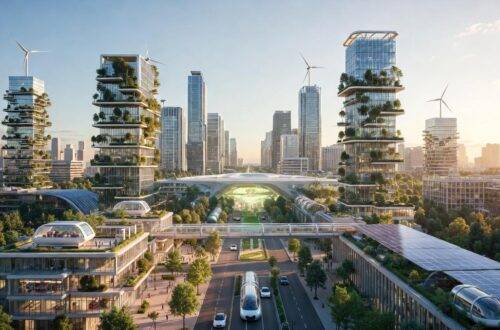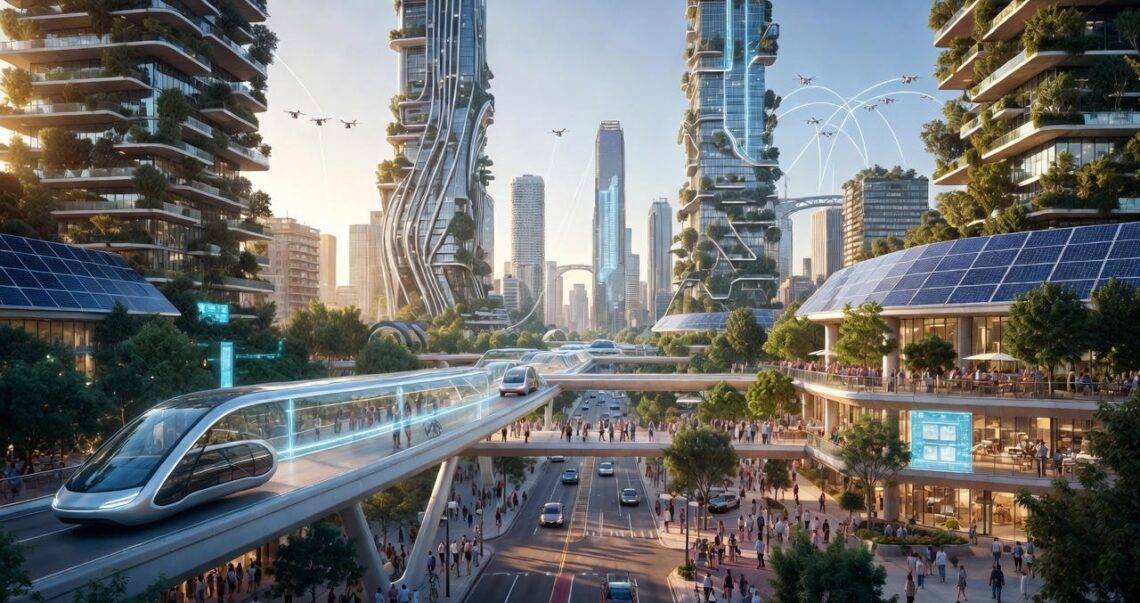
Cities are dying. And being reborn.
The urban landscape that defined the 20th century—car-centric sprawl, concrete deserts, isolated neighborhoods, and choking pollution—is giving way to something radically different. Tomorrow’s cities are being designed not around automobiles, but around people, sustainability, and technology working in harmony.
From Singapore’s vertical forests to Amsterdam’s car-free neighborhoods, from Seoul’s AI-managed infrastructure to Copenhagen’s carbon-neutral districts, a revolution is quietly transforming how we build, live in, and think about cities.
This isn’t incremental improvement. It’s reimagining urban life from the ground up.
The Vertical Forest: Buildings That Breathe
Traditional skyscrapers: Glass and steel towers, energy-hungry, contributing to urban heat islands, offering little beyond shelter and office space.
Tomorrow’s towers: Living structures where every balcony is a garden, every facade a vertical farm, every rooftop a park.
Milan’s Bosco Verticale pioneered this—two residential towers hosting 900 trees, 5,000 shrubs, and 15,000 plants. The result? Buildings that:
- Absorb 30 tons of CO2 annually
- Produce oxygen equivalent to 30,000 square meters of forest
- Reduce urban temperature by several degrees
- Filter air pollution particles
- Support biodiversity (birds, insects returning to city centers)
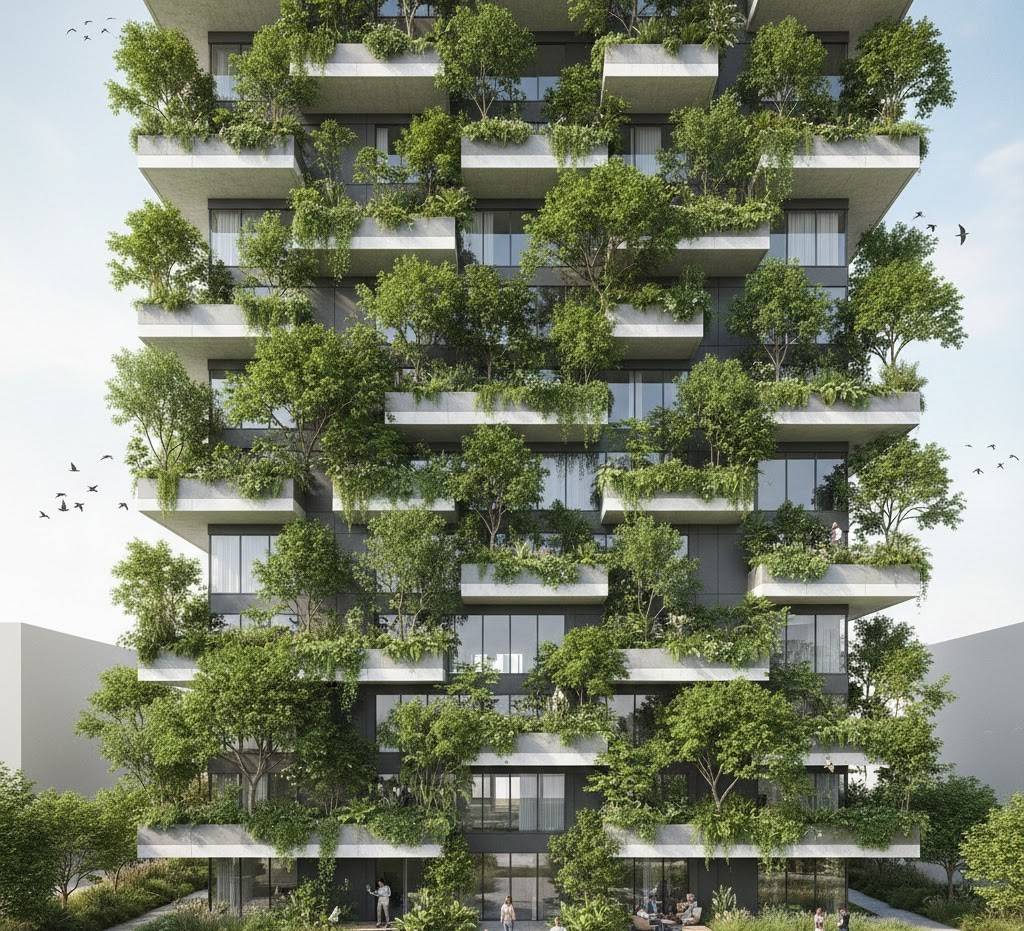
The concept is spreading: Over 50 cities worldwide are constructing vertical forests. Singapore is covering 80% of buildings with vegetation by 2030. These aren’t just aesthetic—they’re functional ecosystems improving air quality, reducing energy needs, and reconnecting urban dwellers with nature.
The 15-Minute City: Everything You Need, Walkable
The problem with sprawl: Americans spend 54 hours yearly stuck in traffic. Europeans average 32 hours. Time wasted, productivity lost, air polluted, communities fragmented.
The solution: Redesign cities so everything essential—work, groceries, healthcare, schools, recreation—exists within 15 minutes of home by walking or cycling.
Paris leads the transformation under Mayor Anne Hidalgo:
- Converting parking spaces to green areas
- Creating extensive protected bike lanes
- Locating amenities in every neighborhood
- Restricting car access to city center
Results: Traffic decreased 40%, cycling increased 300%, neighborhood businesses thriving, community connections strengthening.
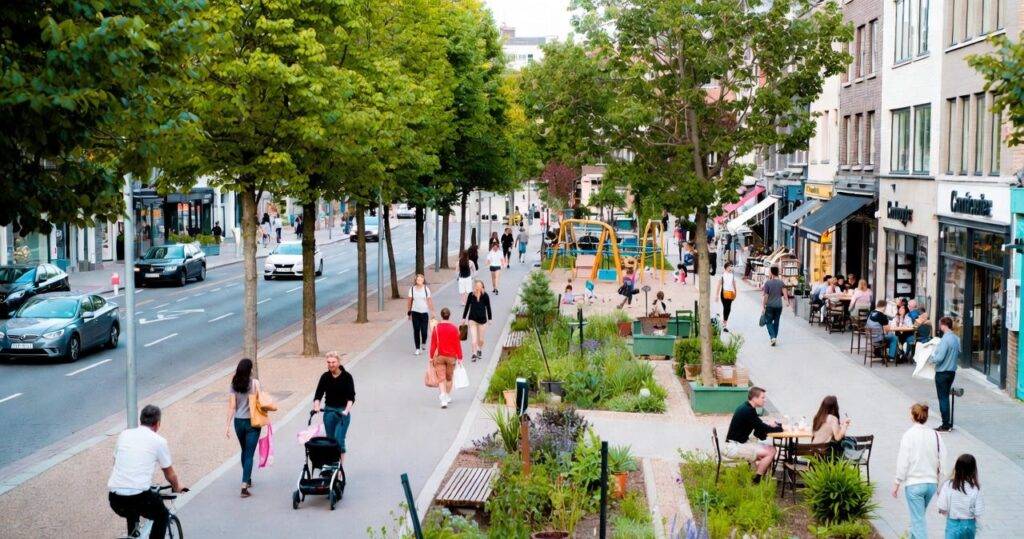
Barcelona’s “superblocks” take it further—closing entire nine-block areas to through traffic, creating pedestrian paradises with outdoor dining, play areas, markets, and public art where cars once dominated.
Smart Infrastructure: The AI-Managed City
Cities generate overwhelming data—traffic patterns, energy usage, water consumption, waste generation, air quality. Tomorrow’s cities use AI to transform data into optimization.
Singapore’s Smart Nation initiative demonstrates the potential:
Traffic management: AI analyzes real-time conditions, adjusting traffic lights dynamically. Result: 25% reduction in congestion during peak hours.
Energy optimization: Smart grids balance supply and demand, integrating solar panels, wind turbines, and battery storage. Electricity waste down 30%.
Predictive maintenance: Sensors detect infrastructure problems before failure—water pipe leaks, bridge stress, road deterioration. Prevention replaces reaction.
Public safety: AI analyzes patterns to position emergency services optimally. Average response time: under 4 minutes citywide.
Environmental monitoring: Real-time air quality measurement with automatic responses—rerouting traffic during pollution spikes, activating filtration systems.
The balance: Gaining efficiency without creating surveillance state. Singapore faces criticism for extensive monitoring, highlighting the tension between optimization and privacy that all smart cities must navigate.
Reclaiming Streets: From Cars to People
The shocking reality: Cities dedicate 30-60% of space to cars—roads, parking, garages. Space that could serve people instead.
Oslo’s transformation: Removing 700 parking spaces from city center, replacing with:
- Bike lanes and pedestrian zones
- Parks, playgrounds, outdoor cafes
- Public art installations
- Community gathering spaces
Initial resistance was fierce. Business owners predicted disaster. Instead:
- Foot traffic increased 40%
- Business revenue grew 20%
- Air quality improved measurably
- Public health indicators rose
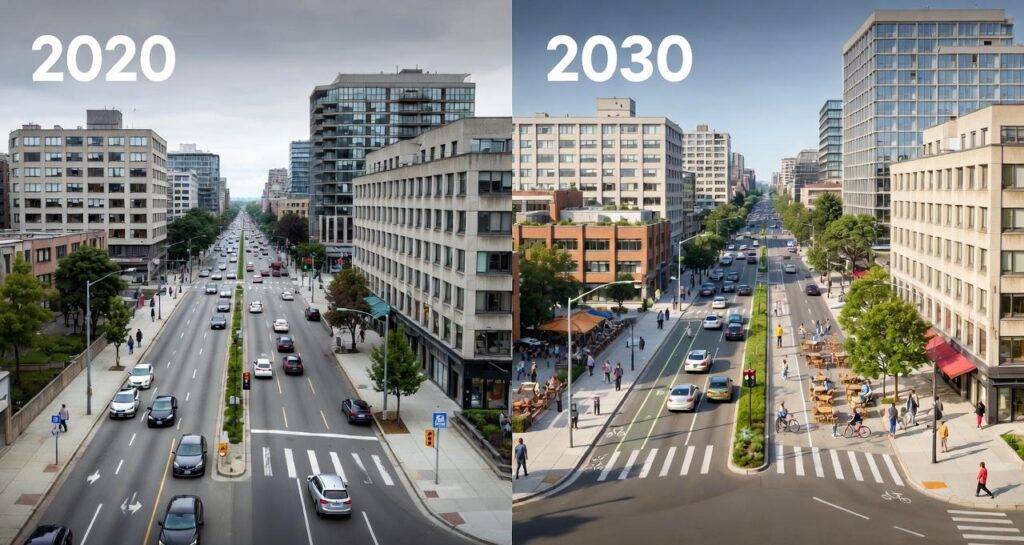
Amsterdam pioneered this decades ago. Today, 60% of trips are by bicycle. The city isn’t just livable—it’s a model for sustainable urban mobility.
The trend accelerates: Paris, Madrid, Brussels, Milan, and dozens more cities are systematically removing car infrastructure and returning space to human use.
Modular Housing: Building Flexibility
Traditional housing: Permanent structures, fixed configurations, decades-long commitments.
Tomorrow’s approach: Modular, adaptable, responsive to changing needs.
Copenhagen’s Urban Rigger demonstrates: Student housing built from repurposed shipping containers arranged in innovative configurations. Benefits:
- Construction time: months, not years
- Cost: 40% less than traditional building
- Sustainability: recycled materials
- Flexibility: can be reconfigured or relocated
- Speed: addressing housing shortages rapidly
Broader applications: Disaster relief housing, temporary workforce accommodation, affordable housing experiments—modular construction enables rapid response to urban challenges.
Transportation Revolution: Beyond the Car
Autonomous vehicles promise congestion reduction, but the real revolution is integrated mobility systems:
Helsinki’s “Mobility as a Service” combines:
- Public transit (bus, metro, tram, ferry)
- Bike sharing (traditional and electric)
- Car sharing (when absolutely necessary)
- Walking routes and real-time info
One app, one payment plan. Result: 30% of Helsinki residents no longer own cars, saving thousands annually while reducing emissions and congestion.
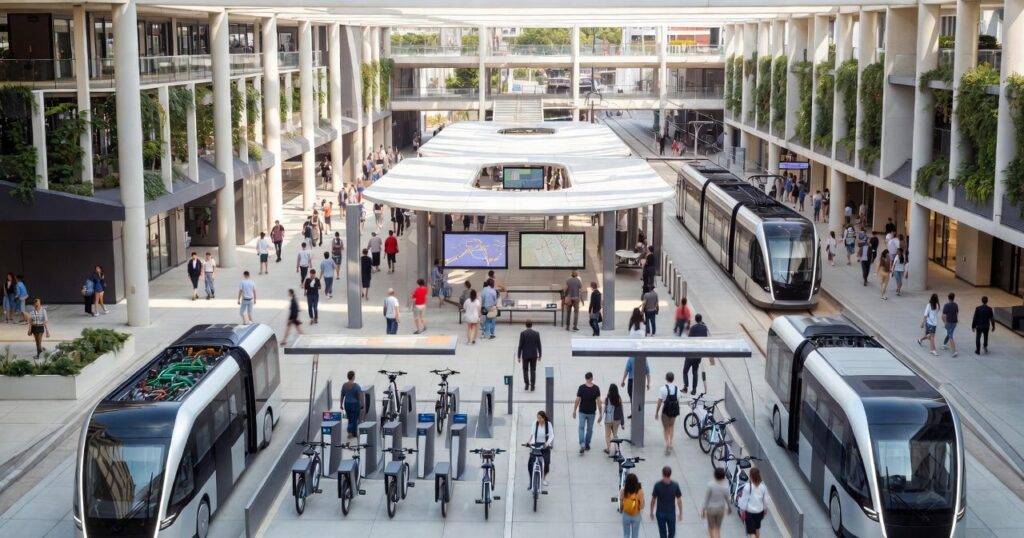
Add emerging tech:
- Electric vertical takeoff aircraft for longer journeys
- Hyperloop connections between cities
- Autonomous shuttles for last-mile connectivity
- Underground freight networks (removing delivery trucks from streets)
Green Infrastructure: Nature as Engineering
Traditional approach: Gray infrastructure—concrete, pipes, mechanical systems managing water, waste, climate control.
Biomimetic approach: Green infrastructure—using nature’s methods to solve urban problems.
Rotterdam’s water squares: Instead of underground storm drains, public squares designed to flood during heavy rain, creating temporary pools that children play in, then gradually draining. Beautiful, functional, climate-adaptive.
Seoul’s Cheonggyecheon Stream: Removed elevated highway, restored buried river. Result: 35% reduction in urban heat, vibrant public space attracting 60,000+ daily visitors, property values increased 30%.
Green roofs mandated in cities from Toronto to Tokyo—reducing stormwater runoff, decreasing energy needs, creating habitats, improving aesthetics.
The Human Element: Community-Designed Cities
The crucial innovation isn’t technology—it’s participation.
Barcelona’s “Decidim” platform lets residents:
- Propose urban improvement projects
- Vote on budget allocation
- Debate policy changes
- Co-design neighborhood transformations
Over 400,000 people participate. Projects range from new parks to housing policies, giving citizens genuine power over urban development.
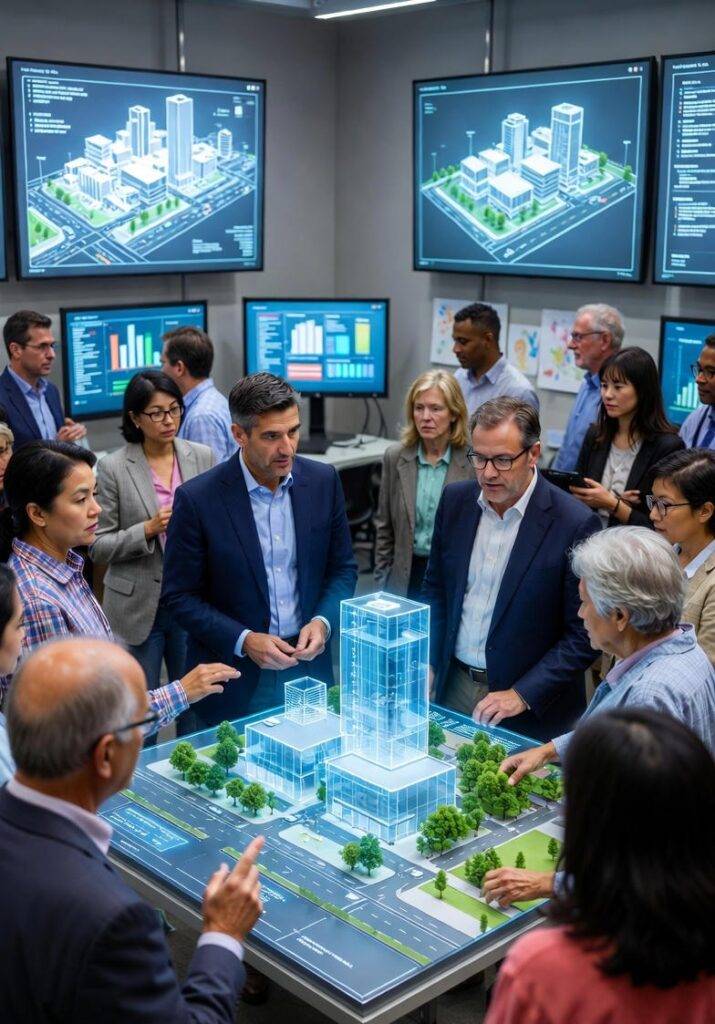
The lesson: Top-down urban planning fails. Cities work when residents shape them.
The Challenge: Equity and Displacement
The uncomfortable truth: Urban improvements can accelerate gentrification, displacing the communities they’re meant to serve.
Green spaces and bike lanes increase property values—wonderful for owners, devastating for renters facing rising costs.
The response:
- Affordable housing mandates in developing neighborhoods
- Community land trusts preventing speculation
- Rent control protecting existing residents
- Participatory budgeting ensuring local priorities
Urban revolution must benefit everyone or it’s just upscale redevelopment, not genuine transformation.
The Cityscape Taking Shape
Tomorrow’s cities are:
- Walkable and bikeable (not car-dependent)
- Green and growing (vertical forests, parks, urban farms)
- Smart but not surveillance (data-driven without privacy invasion)
- Integrated and connected (seamless mobility, mixed-use neighborhoods)
- Community-designed (resident participation, not just expert planning)
- Sustainable and resilient (carbon-neutral, climate-adapted)
The revolution is underway. Not everywhere equally, not without setbacks, but irreversibly. The urban future is being built block by block, policy by policy, innovation by innovation.
And it’s more humane, sustainable, and beautiful than the cities we inherited.