Your watch just saved your life. Not dramatically—no emergency alert, no frantic 911 call. Subtly. It detected microscopic changes in your cardiac rhythm three weeks ago, cross-referenced with your sleep patterns and blood chemistry, and quietly scheduled a cardiology appointment. The doctor found an early-stage condition, treated it easily, and you never experienced symptoms.
Welcome to 2050, where the device on your wrist isn’t just tracking steps—it’s your personal physician, your executive assistant, your security system, your payment method, your communication hub, and increasingly, an extension of your nervous system.
The smart watch has evolved from convenient gadget to genuinely intelligent partner. Let’s explore how a device smaller than a cookie has become one of humanity’s most transformative technologies.
Beyond the Screen: The Holographic Interface
The most obvious change: screens are optional.
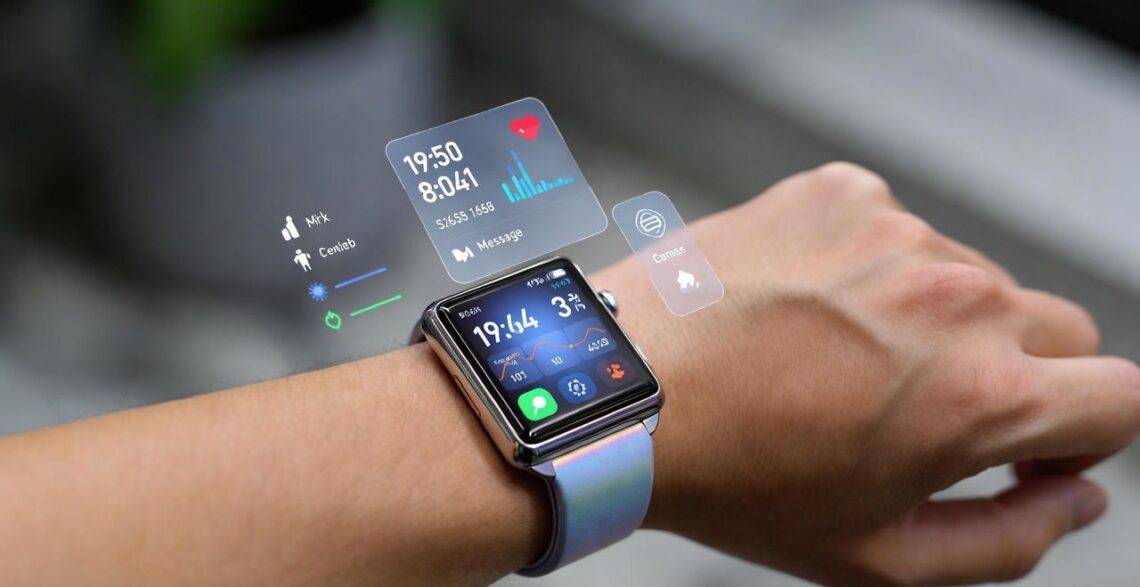
2050’s smart watches project volumetric holographic displays into the air above your wrist. No more squinting at tiny screens—your interface can be as large as you need:
Reading emails? Text hovers at comfortable reading size, 30cm above your arm. Swipe through air to scroll.
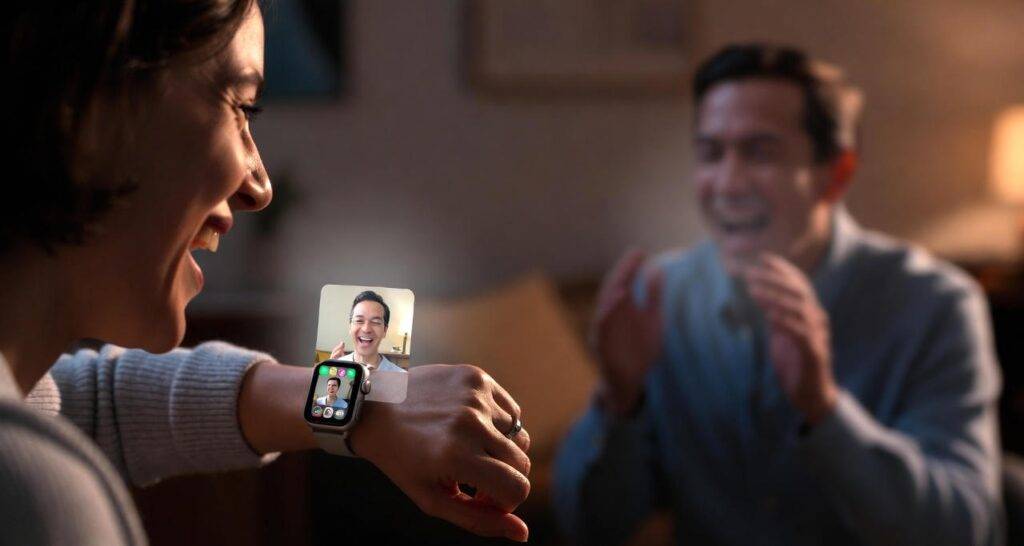
Video call? Your colleague appears as a miniature holographic figure, making eye contact, gesturing naturally.
Navigation? Arrows and directions overlay your actual vision through AR integration, or appear as floating holographic map.
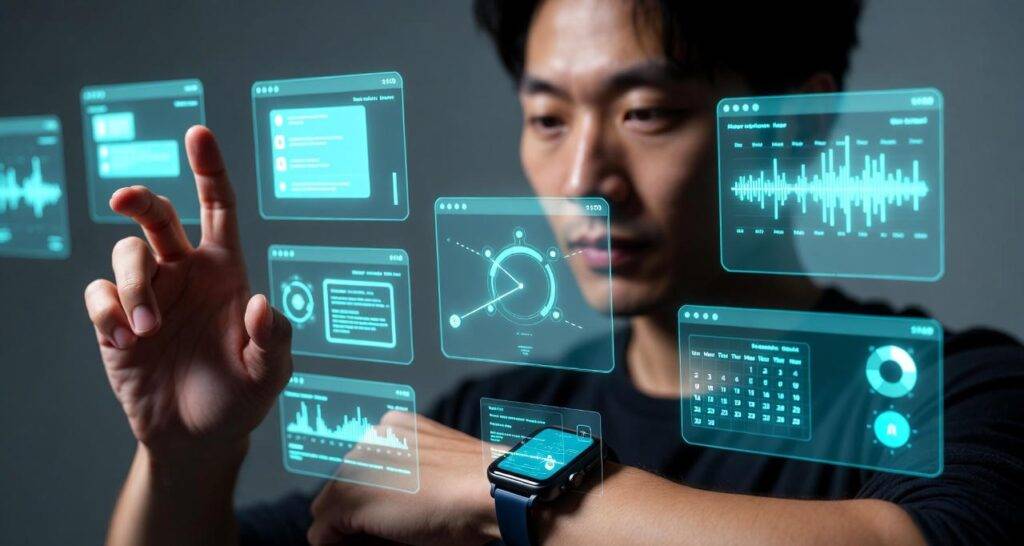
The technology: Femtosecond laser pulses ionizing air molecules to create visible plasma points, forming three-dimensional images suspended in space. Sounds dangerous—it’s not. Power levels are microscopic, creating visual display without heat or radiation risk.
Privacy mode: Holographic displays visible only from your viewing angle—others see nothing. Or share mode for collaborative viewing.
The revolutionary part: You control it with thought. The watch reads subtle muscle movements in your forearm (electromyography) or, for premium models, directly interprets neural signals. Think about scrolling—it scrolls. Imagine tapping a button—it activates.
The Medical Marvel: Your Personal Health Guardian
By 2050, the smart watch has become more doctor than device:
Continuous Health Monitoring
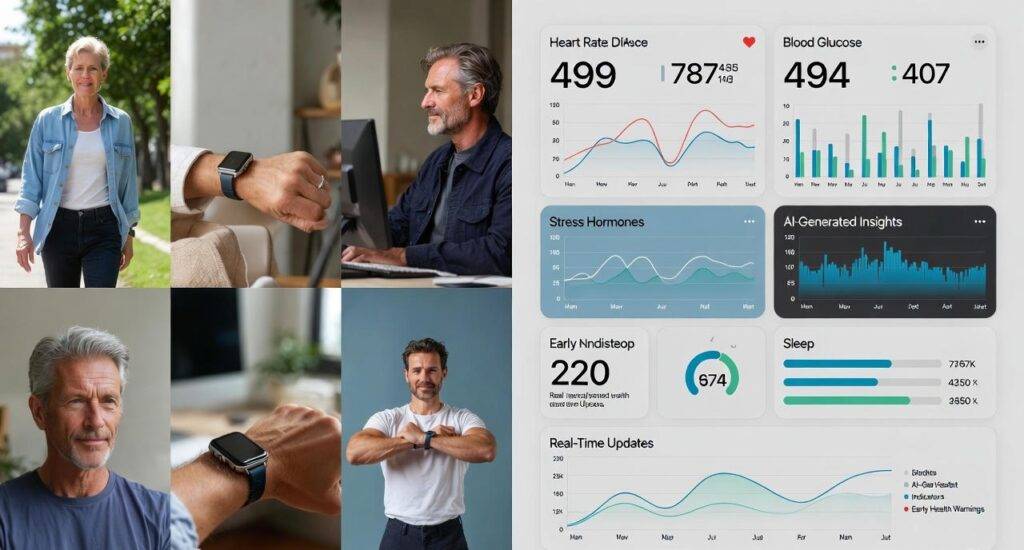
Blood chemistry analysis: Non-invasive optical sensors detect glucose, cholesterol, hormone levels, vitamin deficiencies, even early-stage infections—all from capillaries in your wrist.
Cardiovascular monitoring: ECG, blood pressure, arterial stiffness, stroke volume—comprehensive cardiac data collected continuously, not just during occasional checkups.
Respiratory tracking: Breathing rate, blood oxygen saturation, early detection of respiratory conditions.
Neural activity: Basic EEG readings detecting stress, sleep quality, and even early signs of neurological conditions.
Hydration, body temperature, metabolic rate—dozens of biomarkers tracked 24/7.
Predictive Health AI
The watch doesn’t just collect data—it understands patterns:
- Detects irregular heartbeats six months before clinical symptoms
- Identifies cancer markers from blood protein analysis
- Predicts flu onset 48 hours before you feel sick
- Recognizes early diabetes, thyroid issues, hormonal imbalances
- Monitors mental health through stress biomarkers and behavioral patterns
The result: Diseases caught years earlier, when treatment is simpler and more effective. Average lifespan has increased 12 years since 2030, largely due to early detection from wearable AI.
Emergency response: If you have a heart attack, stroke, or serious fall, the watch automatically alerts emergency services with your exact location, medical history, and current vital signs—often before you’re aware something’s wrong.
The Communication Revolution: Beyond Phones
Smart phones are nearly obsolete by 2050. Why carry a separate device when your watch handles everything?
Holographic calling: Project the person you’re talking with as life-sized hologram or miniature figure hovering above your wrist.
Neural communication: Advanced models with brain-computer interfaces enable thought-based messaging. Think your message—it’s transcribed and sent. No typing, no speaking.
Universal translation: Conversation with someone speaking any language is automatically translated in real-time, either as holographic subtitles or audio overlay.
Augmented hearing: The watch connects to micro-speakers (or bone conduction systems) providing perfect audio in any environment—noise cancellation so effective that subway rides become library-quiet.
Social media integration: Your watch curates and displays relevant updates, filters out noise, and even generates AI summaries: “Here’s what happened in your social circles today that you actually care about.”
The Personal AI Assistant That Actually Assists
Unlike primitive 2020s voice assistants that misunderstood half your requests, 2050’s watch AI is genuinely intelligent:
Context-aware: Knows where you are, what you’re doing, who you’re with, and what you need without being told.
Proactive: Doesn’t wait for commands. “Your favorite restaurant has a reservation opening in 20 minutes. I booked it since you’re free and Sarah mentioned wanting to try it.”
Learning: After months with you, understands your preferences, habits, priorities, and quirks. Feels less like algorithm and more like personal assistant who knows you well.
Anticipatory: Traffic on your usual route? Alarm adjusts automatically. Meeting running long? Subsequent appointments automatically rescheduled with apologies sent.
Task automation: “Handle my travel arrangements for next month’s conference” results in optimal flights booked, hotel reserved, ground transportation arranged, schedule optimized—all without follow-up questions.
Biometric Security: You Are the Password
Passwords are extinct. Your watch authenticates you through:
- Unique cardiac rhythm (your heartbeat is as distinctive as fingerprints)
- Vein pattern mapping in your wrist
- Gait analysis (the way you walk)
- Neural patterns (for BCI-enabled models)
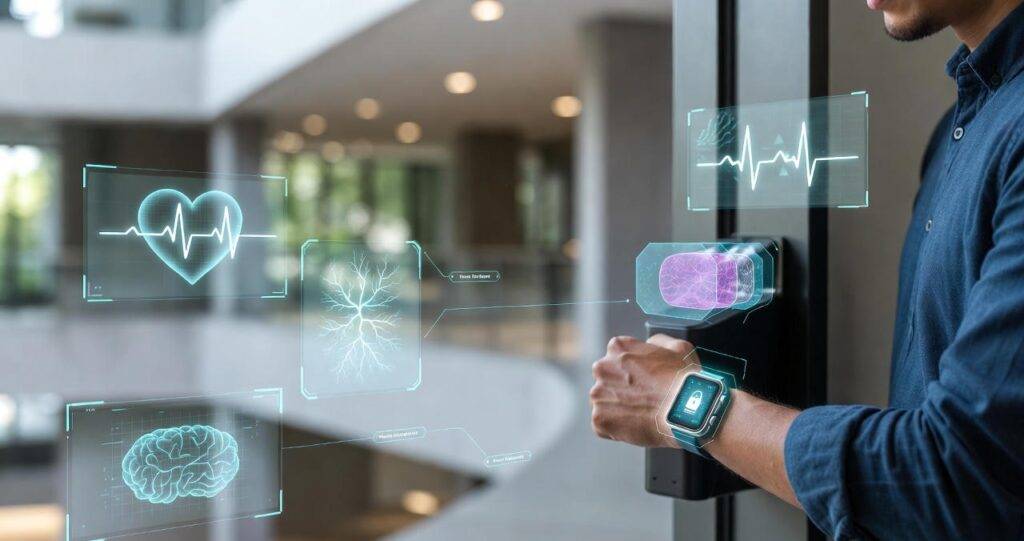
The result: Automatic access to everything—homes, vehicles, offices, payment systems. You never unlock anything manually. The watch constantly verifies identity and grants access appropriately.
Security paradox: It’s simultaneously more secure (biometrics can’t be stolen like passwords) and more convenient (never remember or type anything).
Fraud is nearly impossible: Your unique biological patterns can’t be replicated. Even advanced deepfakes and synthetic biology can’t fool multi-modal biometric verification.
The Fashion Statement: Technology as Jewelry
By 2050, smart watches have become status symbols and fashion accessories:
Materials: Premium models use lab-grown diamonds, graphene-reinforced titanium, bioengineered leather, or even living bio-composite materials that self-heal and adapt color.
Customization: Nanotechnology allows instant appearance changes—switch from sporty to formal to casual with thought command. Change color, texture, even shape.
Designer collaborations: Luxury fashion houses design smart watch “skins” and interfaces. Your watch can look like vintage Rolex, contemporary minimalism, or avant-garde art piece.
Digital jewelry: Holographic “gems” and decorative elements that don’t physically exist but appear stunningly real through AR integration.
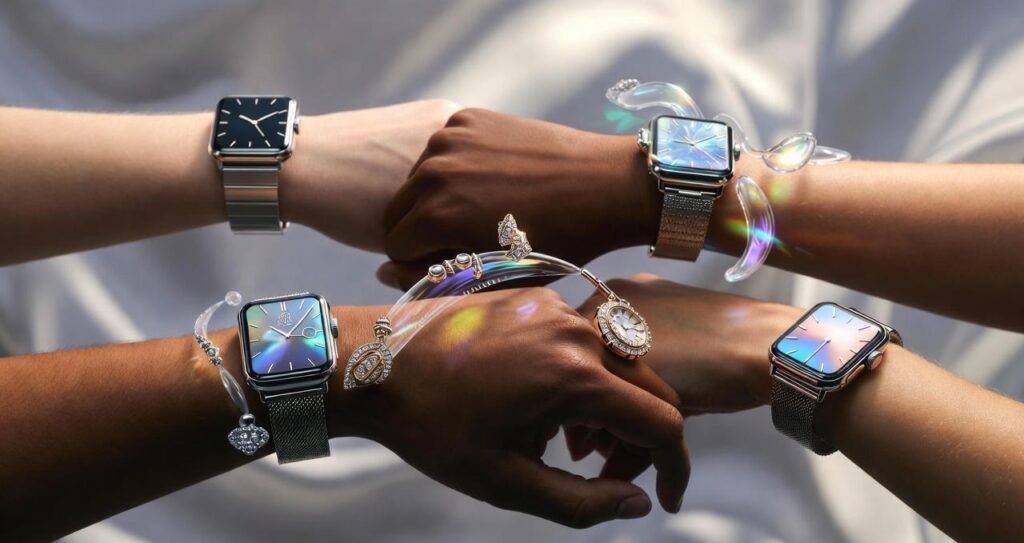
Social statement: Your watch reflects personality, values, status—like luxury watches always have, but now with computational power that makes the difference between basic and premium models genuinely meaningful.
The Seamless Ecosystem
Your watch is the hub connecting everything:
Smart home control: Lights, temperature, security, entertainment—all managed from your wrist with gesture or thought.
Vehicle integration: Your car unlocks as you approach, adjusts seat and mirrors automatically, knows your destination before you state it.
Workplace connectivity: Conference room systems activate when you enter, your files appear on any screen, access privileges granted automatically.
Health integration: Doctor visits involve simply granting temporary access to your watch data—complete medical history instantly available.
Financial management: Real-time spending tracking, investment monitoring, automatic bill payment, fraud detection—all invisible until you want details.
Power: The Battery That Never Dies
Early smart watches required nightly charging. By 2050, that’s ancient history:
Kinetic charging: Movement generates electricity (like automatic mechanical watches, but far more efficient).
Body heat conversion: Thermoelectric generators harvest energy from skin temperature differential.
Ambient RF harvesting: Capturing energy from surrounding wireless signals.
Solar collection: Tiny photovoltaics on watch surface.
Advanced supercapacitors: Store harvested energy efficiently with zero degradation.
Result: Watches that never need charging. Ever. Put it on once, wear it for years.
The Challenges We’re Solving
2050’s smart watches aren’t perfect. Challenges include:
Privacy concerns: Device monitoring everything raises surveillance worries. Regulations mandate user control—you decide what’s tracked and shared.
Digital divide: Premium models cost $5,000-$15,000. Ensuring basic versions remain affordable and accessible is ongoing social challenge.
Health anxiety: Constant monitoring can create hypochondria. AI learns to report only meaningful changes, not normal fluctuations.
Dependence: People feel naked without their watch. Encouraging healthy disconnection and device-free time is cultural conversation.
Security risks: If device authenticates everything, compromising it is catastrophic. Multiple redundant security layers mitigate but don’t eliminate risk.

Life With Intelligent Wrists
Morning: Watch detects optimal wake time based on sleep cycle analysis, wakes you gently. Displays personalized news summary, schedules, and weather.
Commute: Automatically pays for transit, guides optimal route, summarizes work emails, suggests podcast based on your mood and available time.
Work: Facilitates video calls, takes meeting notes, reminds you to stand and move, monitors stress levels and suggests breaks when needed.
Exercise: Provides real-time coaching, tracks performance metrics, adjusts workout based on recovery status and goals.
Evening: Helps with dinner planning (considering nutrition needs and preferences), manages home environment, facilitates social connections.
Night: Tracks sleep quality, adjusts bedroom temperature and lighting automatically, processes health data and generates insights for tomorrow.
All day: Handles hundreds of micro-tasks invisibly—authentication, payments, communication, information retrieval—with zero conscious effort required.
The Transformation Beyond the Device
The profound change isn’t the technology—it’s how we live:
Time reclaimed: Administrative tasks, information lookup, device management—hours weekly recovered through automation.
Health empowered: Proactive rather than reactive medicine. Prevention rather than treatment.
Capability enhanced: Augmented memory, instant information access, seamless communication—human potential expanded.
Barriers removed: Language, distance, physical limitations—increasingly irrelevant.
Connection deepened: Technology enabling rather than hindering human relationships.
Looking Forward: 2060 and Beyond
Even as 2050’s watches seem miraculous, next generation approaches:
- Neural mesh integration: Direct brain connectivity without external components
- Biointegrated systems: Technology grown within body rather than worn externally
- Quantum sensing: Detecting phenomena currently invisible
- Consciousness expansion: Augmenting cognitive capabilities beyond current human limits
But perhaps the most important evolution: Technology becoming invisible. The endpoint isn’t more obvious devices—it’s capability without apparatuses, enhancement without encumbrance.
The watch might eventually disappear entirely—not because technology regresses, but because it integrates so completely with humanity that the distinction between biological and technological becomes meaningless.
The Watch That Changed Everything
The journey from 2015’s primitive fitness trackers to 2050’s intelligent companions represents more than technological progress—it’s human evolution accelerated.
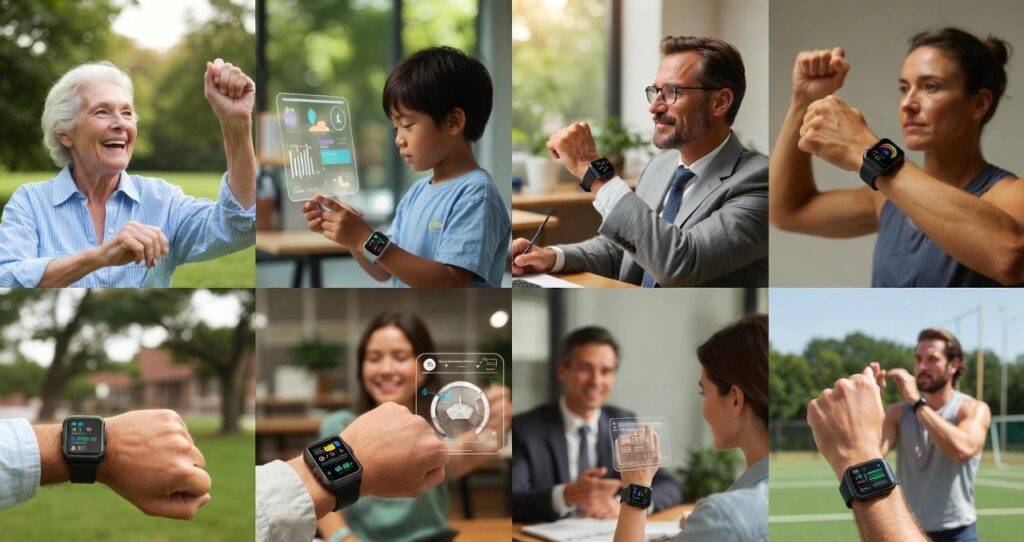
We’re not just wearing smarter watches. We’re becoming smarter humans—augmented by artificial intelligence, empowered by information, protected by proactive healthcare, connected across distances, capable beyond our biological baselines.
The device on your wrist in 2050 is simultaneously your doctor, assistant, guardian, communicator, identifier, and companion. It knows you better than anyone else and serves you without judgment or agenda.