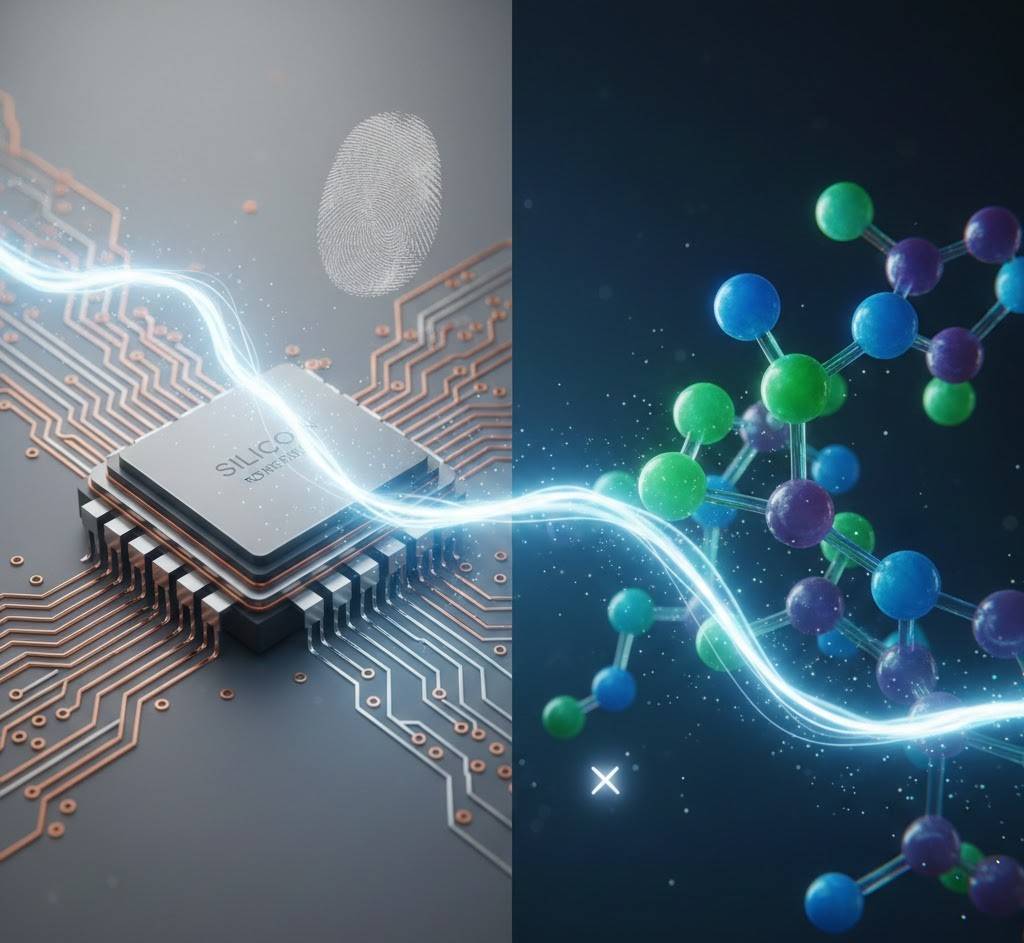
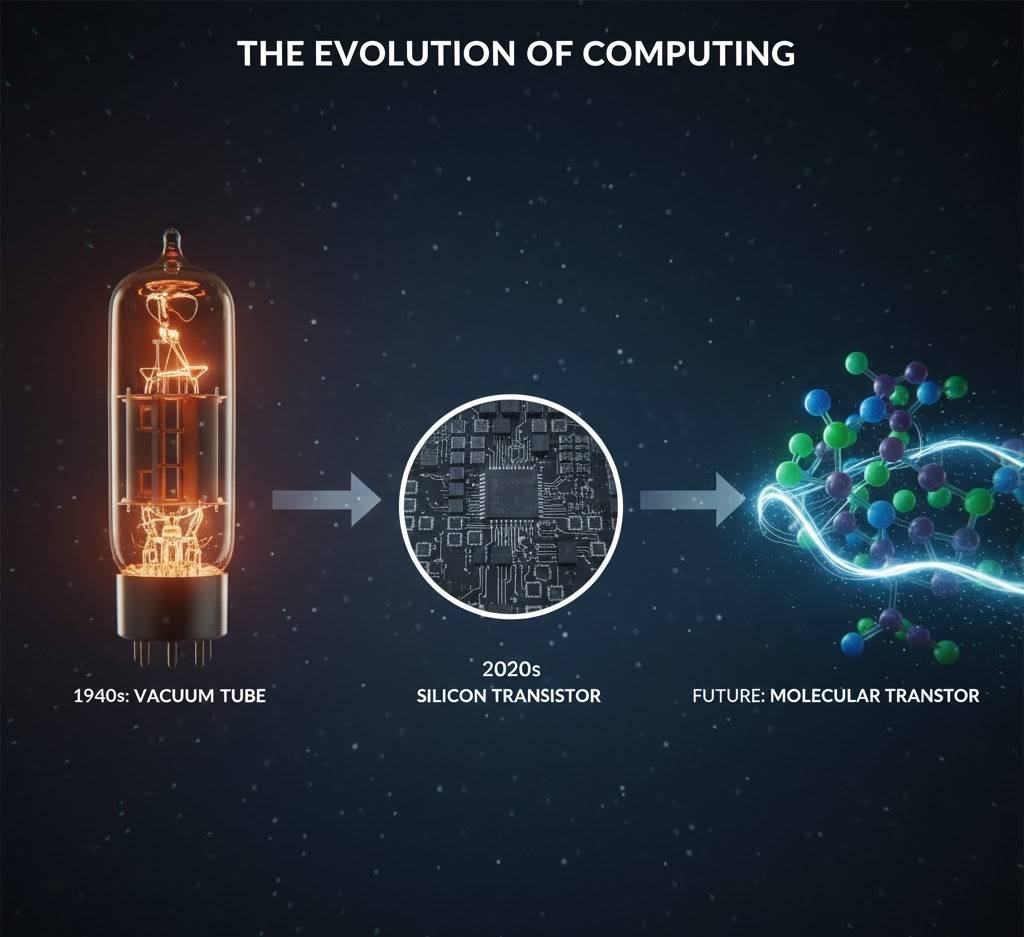
Your smartphone contains billions of transistors, each carved from silicon using technology that’s reaching fundamental limits. We’ve made them smaller every year for decades, but physics is about to say “no more.”
Silicon transistors are approaching atomic scale—literally. You can’t make them much smaller without quantum effects causing them to leak electricity or behave unpredictably. Moore’s Law, the observation that computing power doubles roughly every two years, is ending.
Unless we abandon silicon entirely.
Enter molecular transistors: switches and logic gates built from individual molecules, operating at scales where traditional electronics become impossible. These aren’t marginal improvements—they’re a complete reimagining of computation at the atomic level.
What Makes Molecules Perfect Computing Components?
Traditional transistors are carved from silicon wafers through photolithography—essentially using light to etch patterns. But there’s a limit to how small you can carve.
Molecules, however, are naturally small—a few nanometers across—and self-assemble with atomic precision. Why carve tiny structures when chemistry can grow them exactly?
Key advantages:
Unbelievable density: A single molecule can function as a transistor. Imagine processors with trillions of transistors per square centimeter—thousands of times denser than current chips.
Energy efficiency: Molecular switches require far less power to operate. Phones might run weeks on a single charge. Data centers could reduce electricity consumption by 90%.
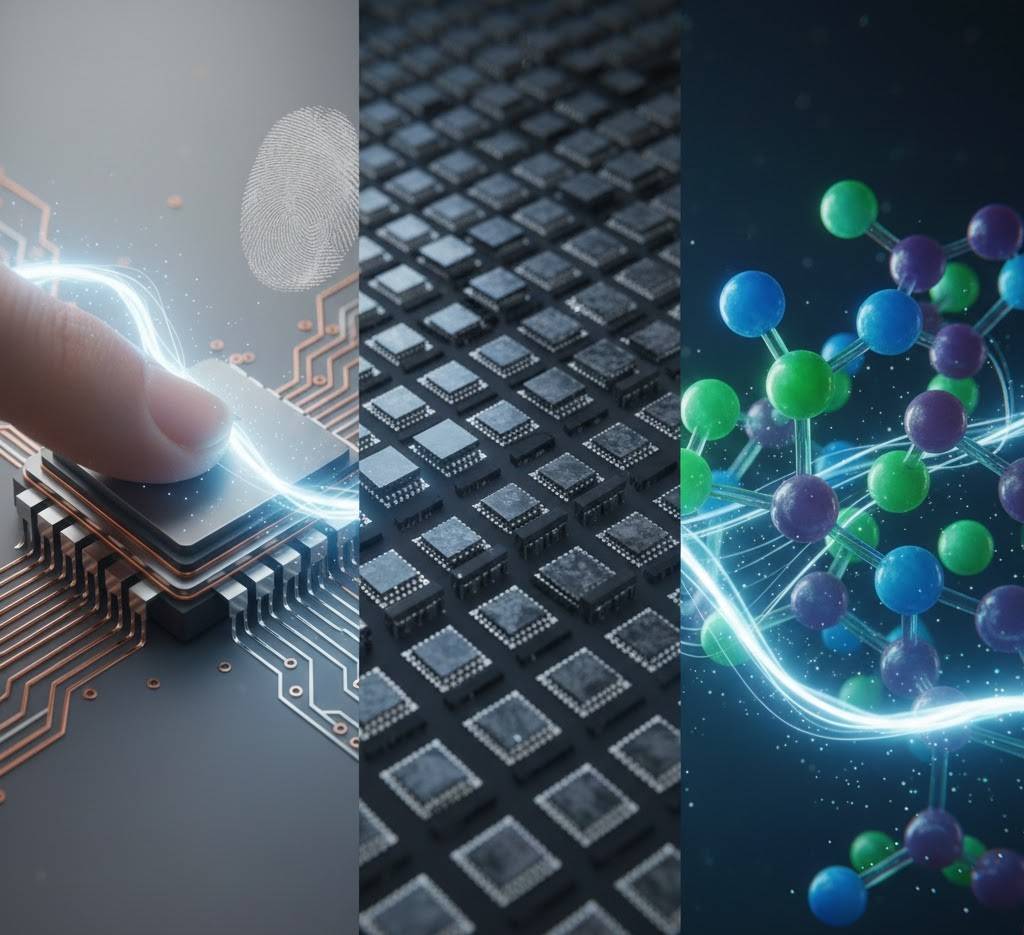
Self-assembly: Molecules naturally organize into functional structures through chemical processes. Manufacturing becomes a matter of growing computers rather than building them.
Three-dimensional architecture: Unlike flat silicon chips, molecular circuits can extend in all three dimensions, creating vastly more complex structures in the same space.
The Breakthrough Molecules
Scientists have identified several promising molecular candidates:
Carbon Nanotubes
Hollow cylinders of carbon atoms behaving as wires or transistors depending on structure. They conduct electricity better than copper while being a fraction of the size.
IBM created the first carbon nanotube transistor in 1998. Today, researchers are building complete circuits with thousands of nanotube components.
The challenge: Growing nanotubes with consistent properties. Each tube must be identical, but chemistry is messy—slight variations create tubes that don’t work.
Graphene
Single sheets of carbon atoms arranged in hexagonal lattice—the thinnest material possible, just one atom thick. Electrons move through graphene faster than any conventional material.
Graphene transistors could operate at terahertz frequencies—hundreds of times faster than silicon. Your computer could process information so quickly that tasks taking hours complete in seconds.
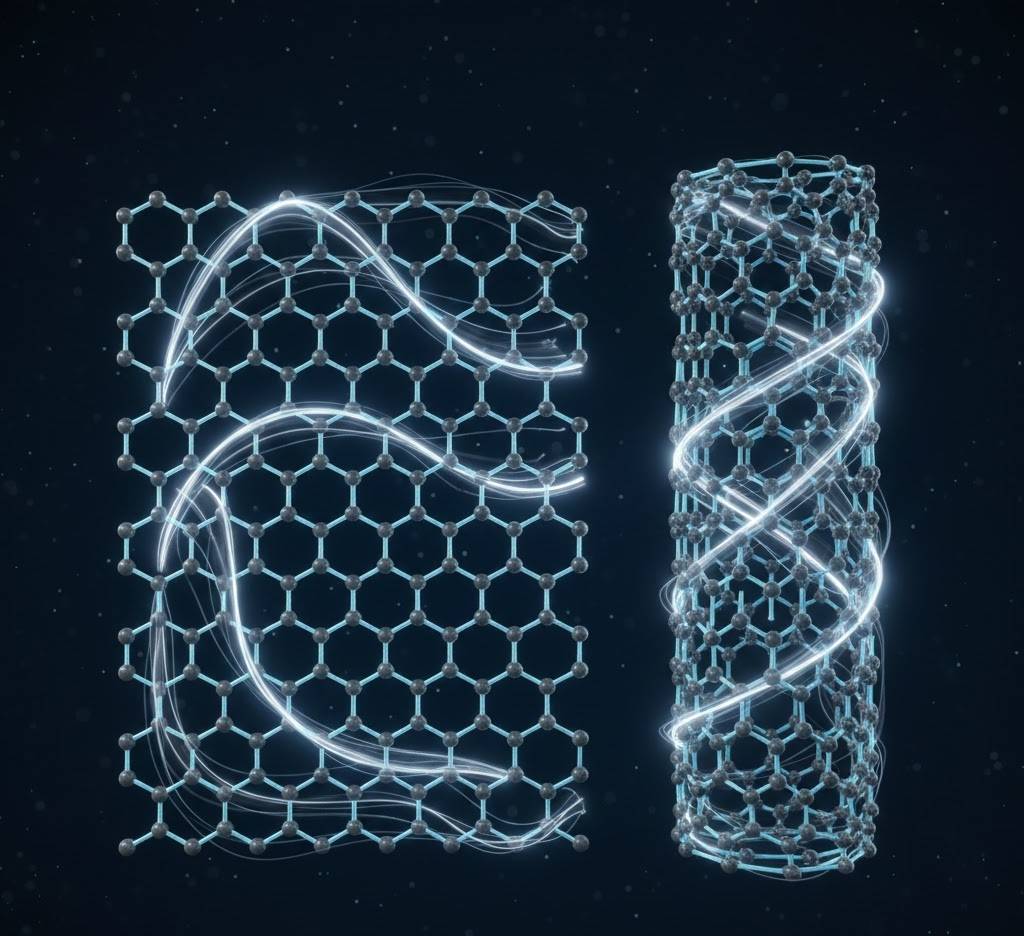
The challenge: Creating transistors that fully turn “off.” Graphene conducts electricity so well it’s difficult to stop current flow—essential for digital logic.
Organic Molecules
Custom-designed molecules synthesized specifically to function as transistors. Scientists can essentially “program” molecular behavior through chemical composition.
Researchers at Columbia University created transistors from single benzene molecules—just 26 atoms functioning as complete switches.
The challenge: Connecting individual molecules to larger circuits. How do you wire something you can barely see with the most powerful microscopes?
How Molecular Transistors Actually Work
Traditional transistors have three parts: source, drain, and gate. Voltage applied to the gate controls whether current flows between source and drain—the basic “on/off” switch enabling all digital logic.
Molecular transistors use the same principle but at atomic scale:
A molecule sits between electrodes (source and drain). A third electrode (gate) applies electric field that changes the molecule’s ability to conduct electricity.
The quantum mechanics are complex, but the outcome is simple: molecules switching between conducting and insulating states, creating the binary logic (1s and 0s) computers need.
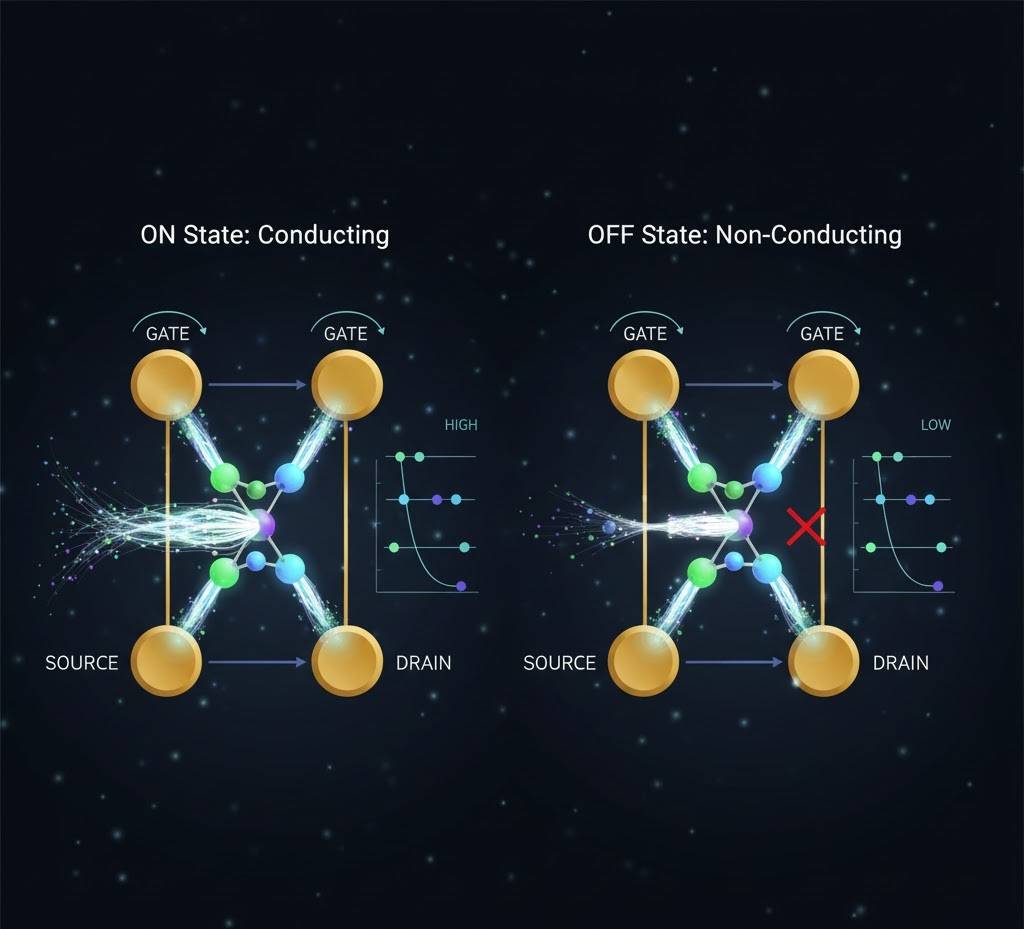
What makes this revolutionary: The entire transistor is the molecule. Not a transistor made from molecules, but the molecule itself functioning as the transistor.
Real-World Progress
This isn’t science fiction. Molecular transistors exist in laboratories worldwide:
2020: University of California researchers created stable molecular transistors operating at room temperature (previous versions required extreme cold).
2022: Chinese scientists demonstrated molecular transistors switching faster than any silicon device—operating at femtosecond speeds (quadrillionths of a second).
2024: First prototype molecular memory device storing data at densities impossible with conventional technology.
Commercial timeline: Conservative estimates put molecular processors in consumer devices by 2035-2040. Optimistic projections suggest 2030.
The Manufacturing Challenge
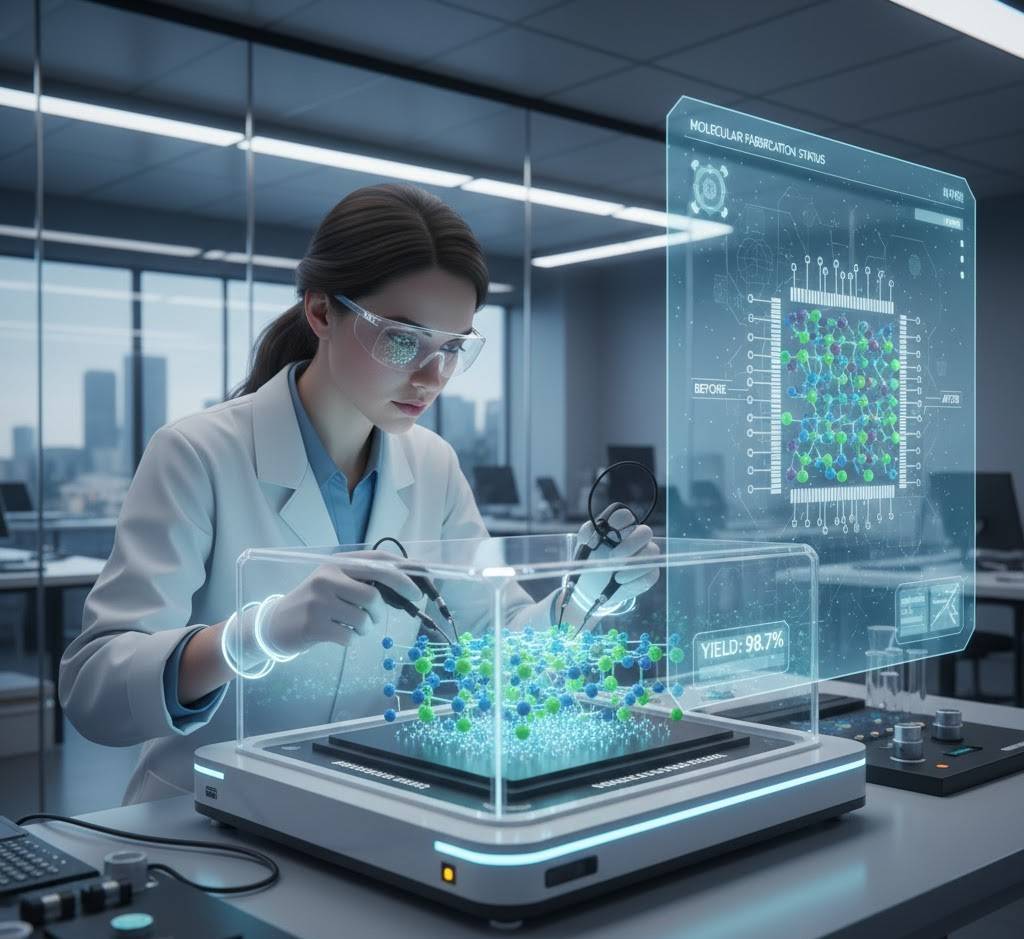
The biggest hurdle isn’t designing molecular transistors—it’s making billions of them reliably.
Current approach: “Bottom-up” assembly where molecules self-organize into circuits through chemical reactions. Like growing crystals, but growing computers.
Challenges:
- Every molecule must be perfect (one misplaced atom breaks the transistor)
- Connecting molecular circuits to conventional electronics
- Mass production at commercial scale
- Quality control at atomic precision
Solutions emerging:
- DNA-guided assembly (using genetic molecules as templates)
- Scanning probe microscopes positioning individual molecules
- Chemical processes that “weed out” defective molecules
- Hybrid approaches combining silicon infrastructure with molecular logic
What This Means for You
When molecular transistors reach commercial viability, expect:
Smartphones with computing power exceeding today’s supercomputers. AI assistants so sophisticated they seem genuinely intelligent. Real-time language translation that’s actually perfect. Augmented reality indistinguishable from physical world.
Medical devices detecting cancer from single cells. Implantable health monitors tracking every biomarker continuously. Personalized medicine analyzing your entire genome in seconds on your phone.
Quantum-level security. Encryption so strong that all current computing power in the world couldn’t crack it in the universe’s lifetime.
Ultra-efficient computing. Data centers using fraction of current power. Climate-friendly AI. Computation becoming effectively free—like how we stopped worrying about calculator battery life.
The Beautiful Irony
We’re approaching the limits of making things smaller using top-down methods (carving silicon). The solution? Work from the bottom up, starting with nature’s smallest building blocks—atoms and molecules.
We’re not just shrinking transistors. We’re fundamentally changing what transistors are.
Silicon served us well for 70 years. But the future belongs to chemistry, quantum mechanics, and molecular engineering.
Welcome to the molecular age of computing—where the impossible becomes inevitable, one atom at a time.