
Remember when “business intelligence” meant spending days creating Excel spreadsheets, only to have them outdated by the time you finished? When finding insights required an army of analysts manually combing through data? When every decision felt like a guess because you couldn’t process information fast enough?
Those days are ending.
Welcome to the era of AI-enhanced analytics platforms—intelligent systems that don’t just crunch numbers but actually understand your business, predict trends before they emerge, and automate decisions that once required hours of human deliberation.
This isn’t about replacing human judgment. It’s about amplifying it with machine intelligence that processes billions of data points while you sleep, surfacing insights you’d never find manually, and automating the routine so humans can focus on strategy.
Let’s explore how AI is transforming analytics from a backward-looking report into a forward-thinking strategic partner.
The Old Way: Analytics as Archaeology
Traditional business analytics suffered from fundamental limitations:
Reactive, not proactive: Reports told you what happened last week or last month—by which time opportunities had passed.
Human-limited processing: Analysts could examine perhaps dozens of variables. Modern businesses have thousands.
Static insights: Create a dashboard showing specific metrics. Miss something crucial because you didn’t know to look for it.
Time-intensive: By the time you gathered data, cleaned it, analyzed it, and created reports, the world had changed.
Siloed understanding: Sales data separate from marketing data separate from customer service data—integrated insights nearly impossible.

The problem wasn’t lack of data. Modern businesses drown in data. The problem was turning data into actionable intelligence fast enough to matter.
The AI Revolution: Analytics That Thinks
AI-enhanced analytics platforms fundamentally change the game by introducing:
Automated Data Integration
Old way: Manually export from CRM, import to spreadsheet, reconcile with sales database, join with marketing data…
AI way: Platforms automatically connect to all data sources—CRM, marketing automation, financial systems, customer support, social media, website analytics—continuously syncing and integrating without human intervention.
Real example: A retail company’s AI platform automatically combines:
- Point-of-sale transactions
- Weather data
- Social media sentiment
- Competitor pricing
- Inventory levels
- Delivery logistics
Result: Predictive insights about which products to stock where, informed by factors humans would never manually correlate.
Predictive Analytics
AI doesn’t just report what happened—it forecasts what’s likely to happen:
Customer churn prediction: Identifying at-risk customers weeks before they leave, enabling proactive retention efforts.
Demand forecasting: Predicting sales fluctuations with 95%+ accuracy, optimizing inventory and staffing.
Maintenance scheduling: Manufacturing equipment failures predicted days in advance, preventing costly downtime.
Market trend detection: Spotting emerging patterns in consumer behavior before competitors notice.

The algorithms learn continuously—each prediction’s accuracy feeds back into the model, improving future forecasts.
Natural Language Queries
Old way: “I need to build a SQL query, generate a pivot table, create a visualization…”
AI way: “Show me which marketing campaigns generated the best ROI last quarter.”
The platform understands natural language, automatically:
- Pulls relevant data from appropriate sources
- Performs necessary calculations
- Creates appropriate visualizations
- Provides context and insights
Even better: “Why did sales drop in the Northeast region last month?”
The AI investigates autonomously, checking dozens of potential factors, and returns: “Sales decreased 23% due to three major factors: competitor launched promotion (captured 15% market share), unseasonable weather (reduced foot traffic), and delayed product shipment (stockouts for top sellers).”

Anomaly Detection
AI constantly monitors all metrics, automatically flagging unusual patterns:
Fraud detection: Identifying suspicious transactions in milliseconds based on subtle pattern deviations.
Quality control: Spotting manufacturing defects by detecting microscopic variations in production data.
Security monitoring: Recognizing cyber threats by identifying abnormal network behavior.
Operational anomalies: Noticing problems before they become crises—website performance degrading, supply chain disruptions emerging, employee productivity shifts.
The key: AI spots anomalies humans wouldn’t notice because it monitors everything simultaneously and recognizes patterns across millions of data points.
Automated Reporting
Monthly reports that used to take 3 days? Now generated automatically, updated continuously, and distributed precisely when stakeholders need them.
Customized for audience: The CEO gets strategic overview. Department heads get operational details. Front-line managers get actionable specifics.
Dynamic, not static: Reports update in real-time. Click any metric to drill down into underlying data and contributing factors.
Real-World Transformations
Let’s see AI analytics platforms in action:
Retail: Predicting the Unpredictable
Challenge: A national retail chain struggled with inventory—too much in some stores (markdowns destroying margins), too little in others (lost sales).
AI solution: Platform analyzing:
- Historical sales patterns
- Local demographic shifts
- Weather forecasts
- Social media trends
- Competitor promotions
- Local events calendars
Result:
- 35% reduction in excess inventory
- 22% increase in sales (fewer stockouts)
- $18 million annual savings
- Automated daily inventory reallocation recommendations

Healthcare: Saving Lives Through Data
Challenge: A hospital network needed to predict patient readmission risk to intervene proactively.
AI solution: Analysis of:
- Patient medical history
- Treatment compliance patterns
- Social determinants of health
- Medication interactions
- Follow-up appointment attendance
- Insurance status
Result:
- 40% reduction in readmissions
- $12 million annual savings
- Better patient outcomes
- Automated risk scoring for every discharge
- Targeted intervention programs for high-risk patients
Manufacturing: Preventing Problems
Challenge: A manufacturer faced unpredictable equipment failures causing production delays and cost overruns.
AI solution: Predictive maintenance analyzing:
- Sensor data from machinery
- Maintenance history
- Environmental conditions
- Production schedules
- Parts supplier delivery times
Result:
- 60% reduction in unplanned downtime
- 30% decrease in maintenance costs
- 25% increase in production capacity
- Maintenance scheduled proactively during planned downtime

Financial Services: Faster, Smarter Decisions
Challenge: A lending institution needed to approve or deny loan applications faster while reducing defaults.
AI solution: Real-time analysis of:
- Credit history
- Income verification
- Employment stability
- Market conditions
- Property valuations
- Social and behavioral data
Result:
- Approval time: 3 days → 15 minutes
- Default rate: 4.2% → 1.8%
- Application volume processed: 3x increase
- Customer satisfaction: 47% improvement
- Automated decisions for 80% of applications
The Technology Stack Behind the Magic
What powers these AI analytics platforms?
Machine Learning Models
Supervised learning: Training on historical data to predict outcomes (sales forecasting, churn prediction, fraud detection).
Unsupervised learning: Finding hidden patterns without predefined categories (customer segmentation, anomaly detection).
Reinforcement learning: Continuously improving through feedback (dynamic pricing, resource allocation).
Deep learning: Neural networks finding complex patterns in massive datasets (image recognition, natural language processing, trend detection).
Natural Language Processing (NLP)
Enables platforms to:
- Understand questions in plain English
- Extract insights from unstructured text (customer reviews, support tickets, emails)
- Generate human-readable explanations of findings
- Summarize vast amounts of textual data
Computer Vision
For visual data analysis:
- Quality control in manufacturing
- Retail shelf monitoring
- Medical imaging analysis
- Security and surveillance
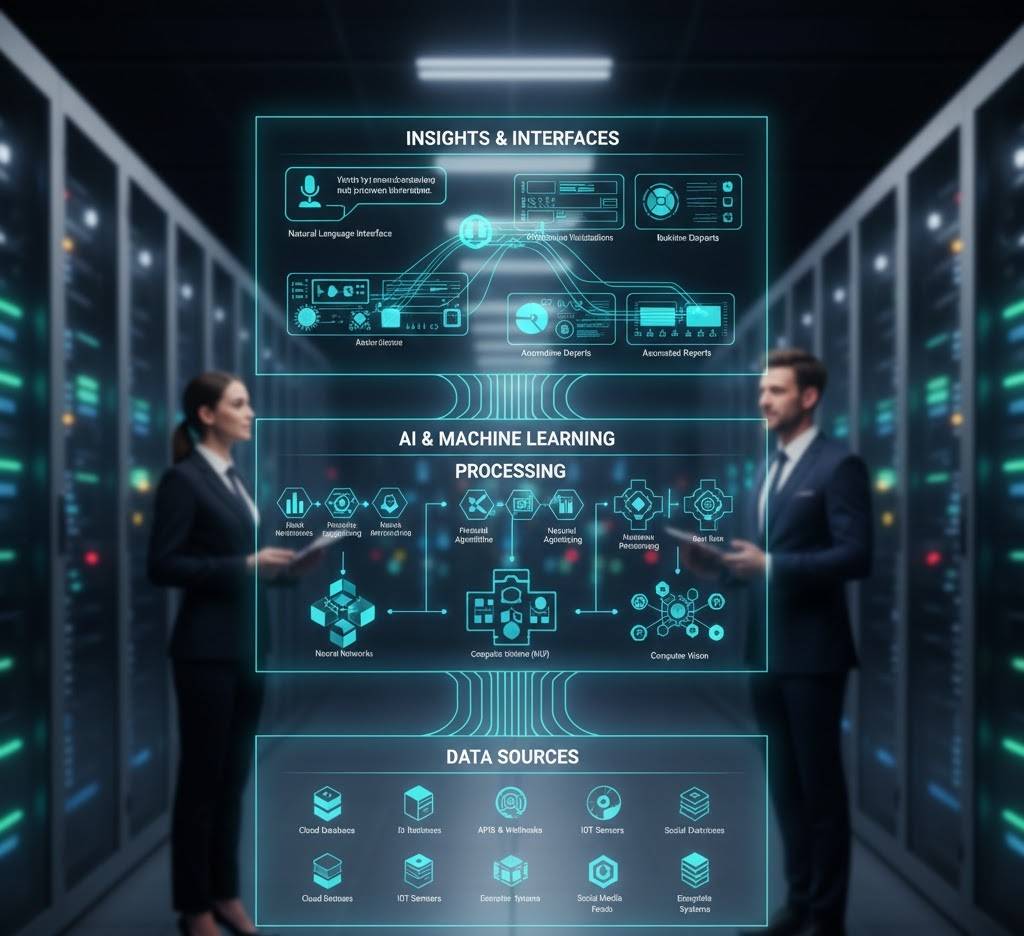
Cloud Computing
AI analytics requires massive computational power:
- Processing billions of records in seconds
- Running complex models in parallel
- Scaling instantly to handle demand spikes
- Accessible from anywhere
AutoML (Automated Machine Learning)
The newest advancement: AI that builds and optimizes its own models.
Traditional ML: Data scientists spend weeks selecting algorithms, tuning parameters, testing variations.
AutoML: Platform automatically tests thousands of model configurations, selecting and optimizing the best performing approach.
Result: Expert-level machine learning accessible to non-data-scientists.
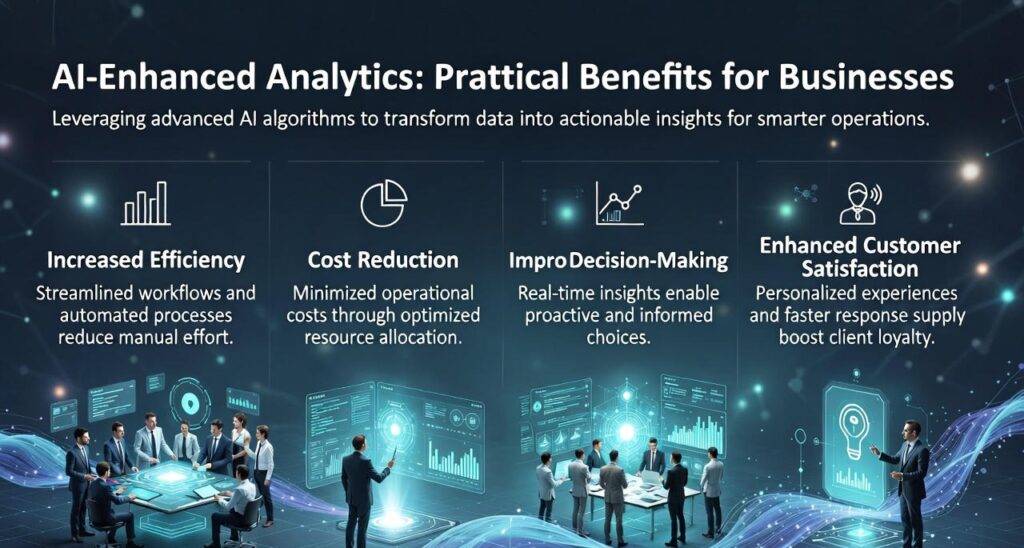
The Practical Benefits: Why Businesses Are Adopting
Beyond the technical impressiveness, AI analytics delivers tangible value:
Speed
Decisions that took days now take minutes. Markets move fast; waiting for weekly reports isn’t viable. Real-time insights enable real-time adaptation.
Accuracy
AI doesn’t get tired, distracted, or biased (at least not in the same ways humans do). Analyzing millions of data points with consistent rigor impossible for humans.
Scalability
One platform handles 10x, 100x, 1000x more data than traditional methods. Growth doesn’t require proportional increase in analytics staff.
Cost Efficiency
Reduced need for manual analysis frees expensive talent for strategic work. Automation eliminates repetitive tasks.
Competitive Advantage
Companies using AI analytics outperform competitors still relying on traditional methods—faster decisions, better predictions, optimized operations
Challenges and Considerations
AI analytics isn’t without hurdles:
Data Quality Issues
“Garbage in, garbage out” remains true. AI amplifies—if your data is flawed, AI produces flawed insights faster.
Solution: Data governance programs ensuring quality, consistency, and completeness.
Implementation Complexity
Integration challenges: Connecting AI platforms to legacy systems can be difficult and expensive.
Change management: Staff must learn to trust and work with AI recommendations.
Solution: Phased rollouts, extensive training, and choosing platforms with strong integration capabilities.
Skill Gap
Data literacy requirements increase. Employees need basic understanding of data concepts to work effectively with AI tools.
Solution: Training programs, user-friendly interfaces, and natural language query capabilities lowering barriers to entry.
Trust and Explainability
“Black box” problem: Sometimes AI reaches conclusions through complex pathways difficult to explain.
Solution: Explainable AI (XAI) showing reasoning behind recommendations, transparency in model training.
Cost
Enterprise-grade AI analytics platforms require significant investment—software licenses, implementation services, ongoing maintenance.
Solution: Start small with focused use cases, demonstrate ROI, expand gradually. Cloud-based pricing models reduce upfront costs.
The Human-AI Partnership
Critical understanding: AI analytics platforms don’t replace human judgment—they enhance it.
AI excels at:
- Processing massive datasets
- Identifying patterns
- Making predictions
- Automating routine tasks
- Working 24/7 without fatigue
Humans excel at:
- Strategic thinking
- Understanding context
- Making ethical judgments
- Building relationships
- Creative problem-solving
- Handling exceptions
The optimal approach: AI handles data-intensive analysis and routine decisions; humans focus on strategy, creativity, and complex judgment calls.

The Future: What’s Coming Next
AI analytics continues evolving rapidly:
Autonomous Analytics (2025-2027)
Platforms that not only analyze but act autonomously:
- Automatically adjusting pricing based on demand
- Reordering inventory without human approval
- Launching marketing campaigns when conditions optimal
- Reallocating resources across organization
With human oversight and guardrails, but operating independently within defined parameters.
Federated Learning (Emerging Now)
Privacy-preserving AI where models train on data without the data leaving its source—crucial for regulated industries and privacy-conscious consumers.
Causal AI (2026-2030)
Moving beyond correlation to understanding causation—not just “these factors correlate with sales increases” but “increasing this factor causes sales growth.”
Enables true optimization: knowing which interventions actually work.
Quantum-Enhanced Analytics (2030+)
Quantum computing enabling analysis of impossibly complex scenarios—optimization problems with millions of variables, perfect portfolio balancing, comprehensive risk modeling.

Getting Started: Practical Steps
For organizations considering AI analytics platforms:
1. Identify Pain Points Where are current analytics processes failing? What decisions take too long? What insights are you missing?
2. Start Small Pilot project with one department or use case. Prove value before enterprise-wide rollout.
3. Ensure Data Readiness Clean, organized, accessible data is prerequisite. Address data quality issues first.
4. Choose the Right Platform Consider:
- Integration with existing systems
- Ease of use for non-technical users
- Scalability for growth
- Vendor support and training
- Industry-specific capabilities
5. Invest in Training Technology adoption requires culture change. Comprehensive training ensures teams leverage AI effectively.
6. Measure and Iterate Track metrics: decision speed, forecast accuracy, cost savings, user satisfaction. Continuously refine approach.
The Transformation is Inevitable
AI-enhanced analytics platforms represent a fundamental shift in how organizations operate—from data-rich but insight-poor to intelligence-driven decision-making at every level.
The companies thriving in coming years won’t be those with the most data (everyone has data). They’ll be those that transform data into intelligence most effectively, make better decisions faster, and automate optimization continuously.
The evolution from manual to smart automation isn’t about eliminating human roles—it’s about elevating them. Freeing people from data drudgery to focus on strategy, creativity, and the uniquely human capabilities machines can’t replicate.
Analytics has evolved from historical reporting to predictive intelligence to autonomous action. The question isn’t whether your organization will adopt AI analytics—it’s whether you’ll lead or follow in this transformation.
The future belongs to organizations that don’t just collect data, but understand it. And the tools to achieve that understanding are here, learning and improving with every query.